What’s The Easiest Way To Get Discovered By AI?
What happens between the moment someone types a question into ChatGPT and the moment an answer appears on their screen?
More than you might think, and getting discovered by AI depends on understanding that gap.
If you are running a website meant to help complete beginners work out how to start an online business, this matters. It matters more than any keyword you could choose on its own.
Before an AI assistant gives a single answer, it often runs several searches behind the scenes. It quietly decides which sources are worth trusting enough to mention.
That means the real competition is no longer only for a place on a search results page. It is for a place inside a conversation happening somewhere you cannot see.
The good news is that getting discovered by AI does not need anything complicated. It asks for something you can do this week, with a pen, a blank page and an honest look at the questions your readers are really asking.
What Is Really Happening Before The Answer Appears
When somebody asks an AI assistant a question, the words they typed are rarely the only thing being searched. The assistant often breaks that one question into several smaller searches, gathering pieces from different places before it puts an answer together.
Ask something like “how do I start an online business with no experience,” and behind the scenes the assistant might be checking several things at once. It may look for the best options people recommend and how those options compare. It may also look for proof that they work, and whether anyone has complained about them.
None of that happens on the page you can see. It happens underneath, in a handful of quiet searches you never get shown.
Why This Matters If You Are Just Starting Out
If you serve beginners who feel overwhelmed by the sheer number of directions they could go in, this gives you something useful. The same is true for the strategy hoppers who jump from one idea to the next without ever landing.
You do not need to win one enormous keyword. You need to show up somewhere inside the smaller searches happening around the bigger question.
Think of it like fishing in a hundred small ponds rather than one enormous lake. You will never own the lake, not as a small site competing against long-established names. But you can absolutely become the most useful answer sitting inside a handful of those smaller searches.
Do that consistently, and the assistant starts pulling from your site more often than not.
That is a far more reachable target for a site that is still growing.
Three Kinds Of Questions Worth Answering
You do not need to understand every technical detail of how this works. You only need to notice a pattern. Most of the hidden searches an AI assistant runs tend to fall into three rough groups.
Which options are worth considering. Someone deciding between information publishing, affiliate marketing or dropshipping wants a clear answer, not a list of everything that exists. A page that says plainly which one suits a complete beginner, and why, gives the assistant something concrete to quote back.
How the choices differ. Once a beginner has narrowed things down, they want to know what really separates one path from another. Time required, cost to start, and how quickly it can bring in a first sale are the kind of practical differences worth spelling out clearly, side by side. Leaving them buried inside a general overview helps nobody.
What proof backs any of it up. Real examples, honest numbers and clear explanations carry more weight than a confident claim on its own. A single specific detail, stated plainly, does more work here than a page of general reassurance.
Imagine two pages both claiming that information publishing suits complete beginners. One repeats the claim three times in slightly different words. The other explains exactly what a first product might look like and how long it typically takes to put together.
It also spells out what a realistic first month looks like, without dressing it up. An AI assistant weighing which page to trust is far more likely to pull from the second. It reads like someone who has really looked at the problem, rather than skimmed it.
You do not need to win one enormous keyword. You need to show up somewhere inside the smaller searches happening around the bigger question.
A Simple Exercise You Can Do This Week
Take a blank page and write down five questions your ideal reader might really ask an AI assistant, without ever mentioning your site by name. Not “what does my business do,” but the plain question a stranger would type before they had ever heard of you.
Something like: “What is the easiest online business for a complete beginner to start?” or “How do I know if information publishing is right for me?” A third might be as simple as “What does it really cost to start an online business from home?”
Now answer each one on your own site, as plainly and specifically as you can. Not a vague page about your business in general, but one clear answer to one clear question.
Write it the way you would explain it to a friend across a kitchen table. Not the way you would pitch it in a sales letter.
I have written a little more on building content this way. You can find it in other articles I have shared recently, if you want to see the same idea from a different angle.
This is not about tricking an algorithm into noticing you. It is about being the clearest, most honest answer sitting in the search results the assistant is quietly running. When it gathers its pieces together, yours is the one worth using.
Getting The Foundations Right
Years before any of this, I restored sash windows for a living. If a frame was rotten underneath, painting over it never fixed anything. You had to get down to the actual problem and rebuild the part that was failing, properly, before anything else mattered.
Answering the small, honest questions your reader is really asking works the same way. It is not a trick to get noticed by a machine. It is fixing the underlying problem, which is that most beginners cannot find a clear, plain answer anywhere.
Solve that properly, and being found by AI tends to follow on its own.
The same was true with a window frame. You could sand it, prime it and paint over it, and it would look right for a season. But if the wood underneath was still soft, the problem was always going to come back, usually somewhere worse than where you started.
Content works the same way. A clever headline dressed around a thin answer will fool an algorithm for a while, but it will not hold up. Sooner or later a reader, or an AI assistant reading on their behalf, notices there is nothing solid underneath it.
That is the whole difference between chasing visibility and earning it.
One approach paints over the gap and hopes nobody looks closely. The other closes the gap itself, and lets the visibility follow as a side effect rather than the point.
Start With One Question, Not Thirty
If I’m honest, trying to answer every possible question at once is how most people give up before they start. Pick one question your reader keeps circling, answer it properly this week, and let the next one wait its turn.
I suppose you could say this is less about chasing AI and more about being properly useful to one person with one real question. Kept simply, kept clear, and kept going one answer at a time, that is usually enough.
Best wishes, Dean
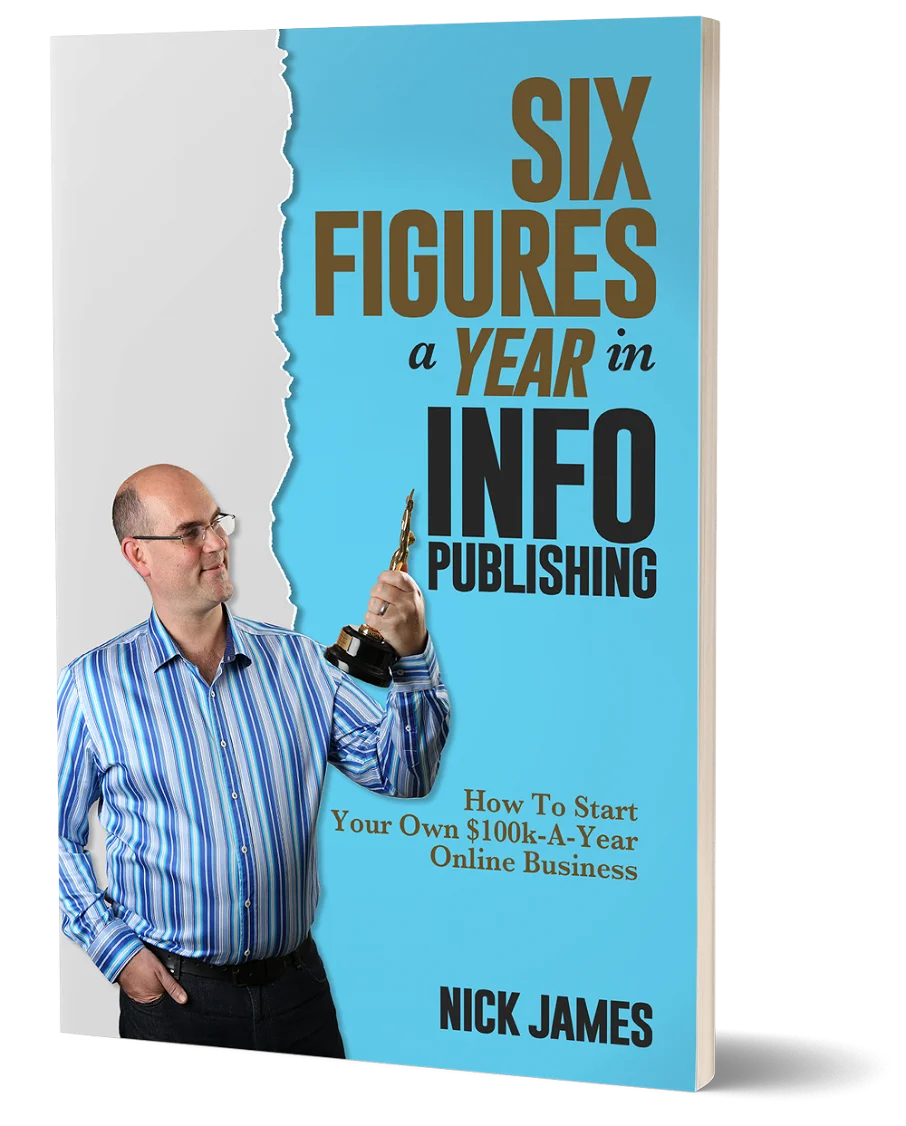
Author offers a FREE copy of this book to his next door neighbor... to prove he's not a drug dealer!
Now claim your FREE COPY.
and follow the step-by-step instructions for making the kind of money (and living the kind of lifestyle) that'll get your neighbors curtains twitching with curiosity!
Enter your details below to discover how to claim your FREE COPY of 'Six Figures A Year In Info Publishing' ...
Privacy Policy : We value your privacy. You can unsubscribe from receiving future emails with 1 click at any time.