The Overlooked Reason Most Digital Products Never Sell
Early on in this business, I bought solo ads to build my email list. Most of the people who signed up never even opened the emails I sent, and I spent somewhere between $2,700 and $3,000 finding that out. If you are staring at a similar spend on ads with nothing coming back, you are not doing anything wrong. You are just missing the piece that decides whether any of it converts.
That was the moment I stopped buying traffic and started building digital products of my own instead. If you are new to this and feeling overwhelmed by the sheer number of directions you could take, here is the part nobody tells you early enough. One product, on its own, rarely pays the bills. It is the second one, the third one, and the tenth one that starts to matter.
I suppose you could say I learned that the expensive way. You do not have to.
Why One Product Rarely Carries a Business
When I was restoring sash windows, nobody built a business on one window. You built a reputation, then a run of jobs, then a list of customers who called you again the next time something needed fixing. The same logic applies to whatever you are building now. One offer is a starting point, not a destination.
Digital products work the same way, if I’m honest, and it took me a while to see it.
Someone with a single guide or template for sale has one door for people to walk through. Someone with ten or twenty related products has ten or twenty doors. Different people notice different things. A person who finds your checklist today might buy your fuller guide next month, simply because they already know your name.
None of this needs to happen overnight. It needs to happen in order, the same way you would not fit a new window before checking the frame underneath it was sound.
Trust Has to Come Before the Sale
Here is something worth sitting with. A product with no reviews, no feedback and no proof behind it is a much harder sell than one with even a handful of honest opinions attached to it. Good or bad, those opinions count.
People cannot hold a digital product, flip through it, or test it before they buy. Anything that reassures them matters more than most sellers admit.
That is why your first few buyers matter more than your next hundred. They are not just customers. They are proof for everyone who comes after them. Ask them what they thought. Ask what else they are struggling with. Use their answers to decide what you build next, rather than guessing. If you have zero reviews right now, that is not a failure on your part. It is just the stage you are at, and it will not last if you keep asking.
Building the Catalogue Properly
I keep coming back to that old trade instinct: get the foundations right, use the right tools for the job, and fix the actual problem instead of covering it up.
With digital products, the foundation is a market that is already spending money on similar things. The tool is a small, useful product built for one specific person’s problem, not a vague attempt to help everyone.
Start smaller than feels comfortable. A short guide, a template, or a simple checklist that solves one clear problem is worth more to a beginner. A huge course nobody finishes is worth nothing. Someone who buys a small checklist today because it solves one specific problem is far more likely to buy your fuller guide next month than someone who bounced off a course they never opened. That is how a catalogue of building digital products actually grows: one small, useful thing at a time, each one earning the right to sell the next.
Build that well, listen to what buyers ask for next, then build the next one from their answers rather than your own guesswork. Whatever problem you are solving, write down the smallest version of it you can build this week, then build that first.
I have written a bit more about how I approached this, and some of the mistakes along the way. You can find that in other articles I have shared recently, if you want the fuller picture.
Owning Your List Changes Everything
The solo ads I bought never became anything, because I never owned the relationship with those people. I was renting attention that belonged to somebody else’s list, for a few hours, and hoping it converted into mine. If you are still renting somebody else’s audience through ads, this is the point where that starts to change for you too.
Once I stopped doing that and started building my own list properly, everything else got easier. Every product I create now goes to people who already know me a little, rather than strangers who clicked once and forgot me by lunchtime.
I run the technical side of that, including this newsletter, through eShowcase. It is not the exciting part of the business, if I’m honest. But it is the part that keeps working quietly in the background while I focus on what I am building next.
Where to Go From Here
You do not need twenty products by next week. You need one, built properly, for one clear problem your reader already knows they have. That is the whole point of building digital products properly instead of chasing the next shiny idea.
If you want a fuller structure for how information publishing actually works, from finding your market through to building out a proper catalogue, Nick James put together a free book. It’s called Six Figures A Year In Information Publishing, and it walks through the thinking behind it in more detail than I have room for here. The approach it teaches lines up with what I have learned the harder way. That includes trial and error, and a fair bit of wasted money on traffic that never went anywhere.
Whatever you build first, build it for one person with one real problem. Everything else, kept going long enough, tends to follow from that.
Best wishes, Dean
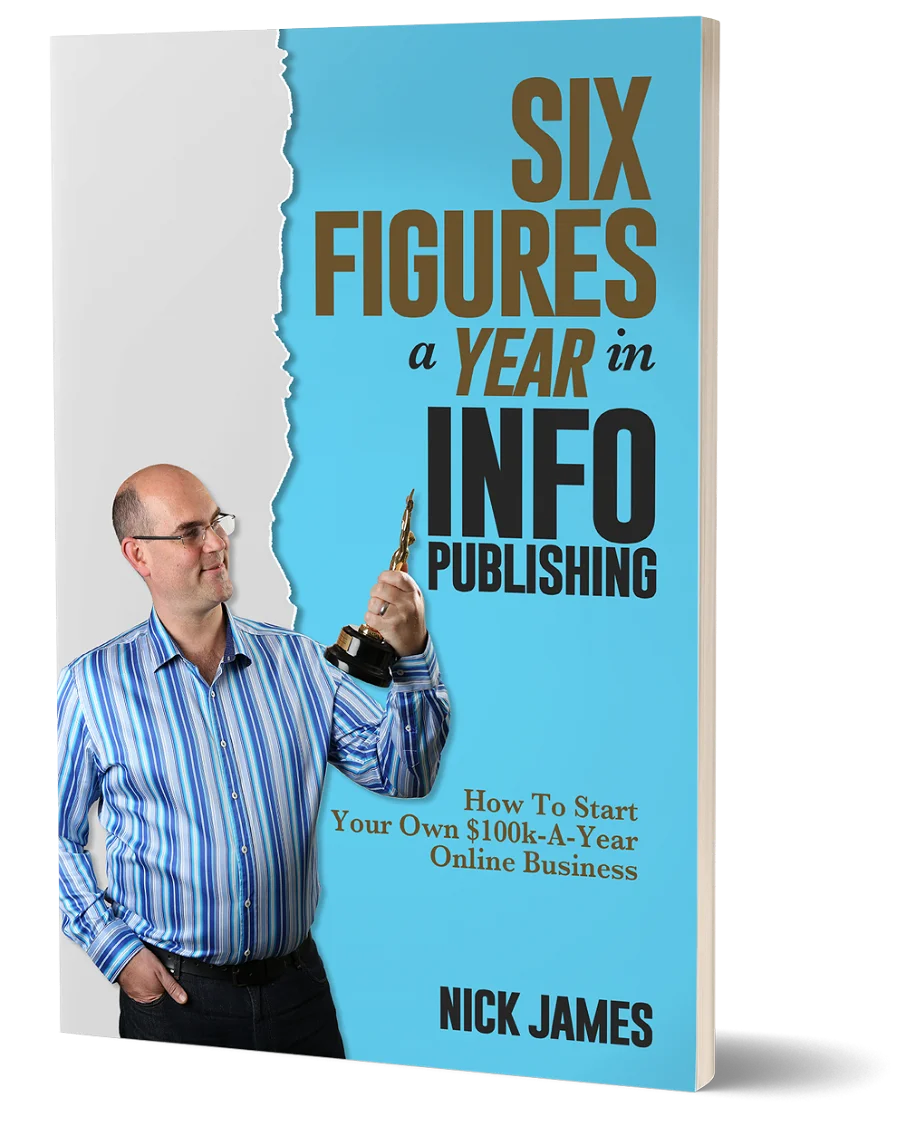
Author offers a FREE copy of this book to his next door neighbor... to prove he's not a drug dealer!
Now claim your FREE COPY.
and follow the step-by-step instructions for making the kind of money (and living the kind of lifestyle) that'll get your neighbors curtains twitching with curiosity!
Enter your details below to discover how to claim your FREE COPY of 'Six Figures A Year In Info Publishing' ...
Privacy Policy : We value your privacy. You can unsubscribe from receiving future emails with 1 click at any time.