The Smart Secret Behind A Content Library That Gets Found
You publish something useful, and a week later it is gone. It sinks beneath everything else that got posted in the meantime, and you are left wondering whether the hour it took was worth it.
Beginners exploring online business hear the same advice from every direction: try this platform, then that one, chase whatever is trending this month. It is easy to jump from affiliate marketing to dropshipping to coaching without ever staying anywhere long enough to build something that actually lasts.
There is a steadier way to think about your content. Instead of chasing whatever is trending, build a content library: a set of clear answers to the exact questions your readers are already asking, connected to each other so they support one another. That library keeps working long after a trend has moved on to something else.
Trends Fade. Questions Do Not.
A trending sound, a viral format or a hot new platform feature has a short life. It spikes, everyone piles on, and within weeks the algorithm has moved its attention elsewhere.
A business tip built around this week’s algorithm change might get attention for a few days. Once the algorithm changes again, the tip is stale, and nobody searches for it any more.
The question your reader typed into a search bar last year is often the same one they will type next year. “How do I stop my puppy biting” does not go out of fashion. Neither does “how do I price my first product” or “how do I get my first hundred subscribers.”
Chasing trends means starting from zero every single time. Answering real, recurring questions means every piece you publish can still be found months, sometimes years, after you wrote it.
Think about the last time you searched for something practical rather than something entertaining. You were probably not chasing a trend at all. You were trying to solve a problem that has existed for years and will still exist next year.
Building Something That Keeps Getting Found
Most people publish whatever occurs to them that day. A tip here, an opinion there, no real connection between one piece and the next. It feels productive, but it rarely adds up to anything a reader, or a search engine, can make sense of.
A content library works differently. You pick a handful of topics your reader actually cares about, then answer specific questions inside each one, so the pieces reinforce each other rather than sitting alone.
Say your focus is beginner information publishing. You might answer how to pick a first topic, how to price a first product and how to get early subscribers, then link each answer into the next so a reader moving through them feels guided rather than dropped into a random list.
I have written a bit more about repeatable content formats in other articles I have shared recently. The pattern keeps showing up: structure beats randomness, almost every time.
Picture two beginners writing about starting an online business. One publishes whatever crosses their mind that week. The other answers a set list of specific questions their reader is already typing into Google, and links each answer to the next.
A year later, the second beginner has a set of pages that still gets found. The first has a folder of posts nobody is looking for any more.
What Changed When I Stopped Publishing At Random
I run a second site called FAQ Marketing Logic as something of an experiment alongside my main business. Instead of publishing whatever crossed my mind that week, I organised the whole thing around six connected topics: business, traffic, email, conversion, systems and scale.
Each topic got broken into specific questions, and each article was built to support the ones around it. If I am honest, nothing happened for a long stretch. I suppose you could say it felt like shouting into an empty room.
I kept going anyway, largely because the trades background I come from taught me that fixing the underlying problem takes longer than papering over it, but it holds up better.
Then, by September, Google Search Console was showing more than 4,000 impressions over the previous three months. Some 78 of the site’s pages were appearing in search. Not a huge number, and I would not call it high-traffic or a proven formula.
It is still early days.
What did make me sit up was smaller than that, and more specific. Google’s AI Overview had used one of the FAQ Marketing Logic articles as a source. The question it answered was how to turn a skill into a sellable offer.
Search visibility can move around, and this is only a snapshot from September 2026, but it told me the patient, structured approach was starting to work.
Trends fade. The questions people ask do not.
How To Start Your Own Content Library
You do not need six pillars or a spreadsheet to begin. You need three things, done properly, one at a time.
Pick one promise. Not “marketing” or “online business.” Something specific, like helping complete beginners find their first realistic starting point in information publishing.
List the actual questions. Write down twenty or thirty things your reader would type into a search bar, not the topics you feel like covering. “How do I choose between affiliate marketing and my own product” beats “getting started” every time.
Answer one question fully, then connect the next one to it. Mention the earlier piece where it genuinely helps, and let each new answer point somewhere else useful. That is the whole mechanism behind a library that keeps getting found, rather than a pile of separate posts.
This is slower than publishing at random. It also means that six months from now, your best pieces are still doing the work, instead of vanishing under everything published since.
Keep the list visible. Pin your twenty or thirty questions somewhere you will actually see them, and tick each one off as you answer it properly. A library built this way grows steadily, one solved question at a time, rather than in occasional bursts.
The One Question Worth Asking Before You Publish
Before your next piece goes out, ask yourself one thing: is this answering something people will still be typing into a search bar next year, or is it riding this week’s trend?
Neither answer is wrong.
But if everything you publish is the second kind, you are rebuilding your audience from nothing every single month. Building even a handful of pieces that answer the first kind of question gives you something that keeps earning its place, long after you have moved on to the next thing.
Where This Naturally Leads
If you are still working out which direction to build in at all, that decision matters more than any single article or platform trick. Six Figures A Year In Information Publishing is a free resource Nick James put together for exactly that stage: choosing a direction in information publishing before you spend months producing content for the wrong one.
It will not replace the work of building your own answers to your reader’s questions, but it gives you a clearer starting point for deciding what those questions should be. If working out that first direction feels like the missing piece, it is worth a look.
Best wishes,
Dean
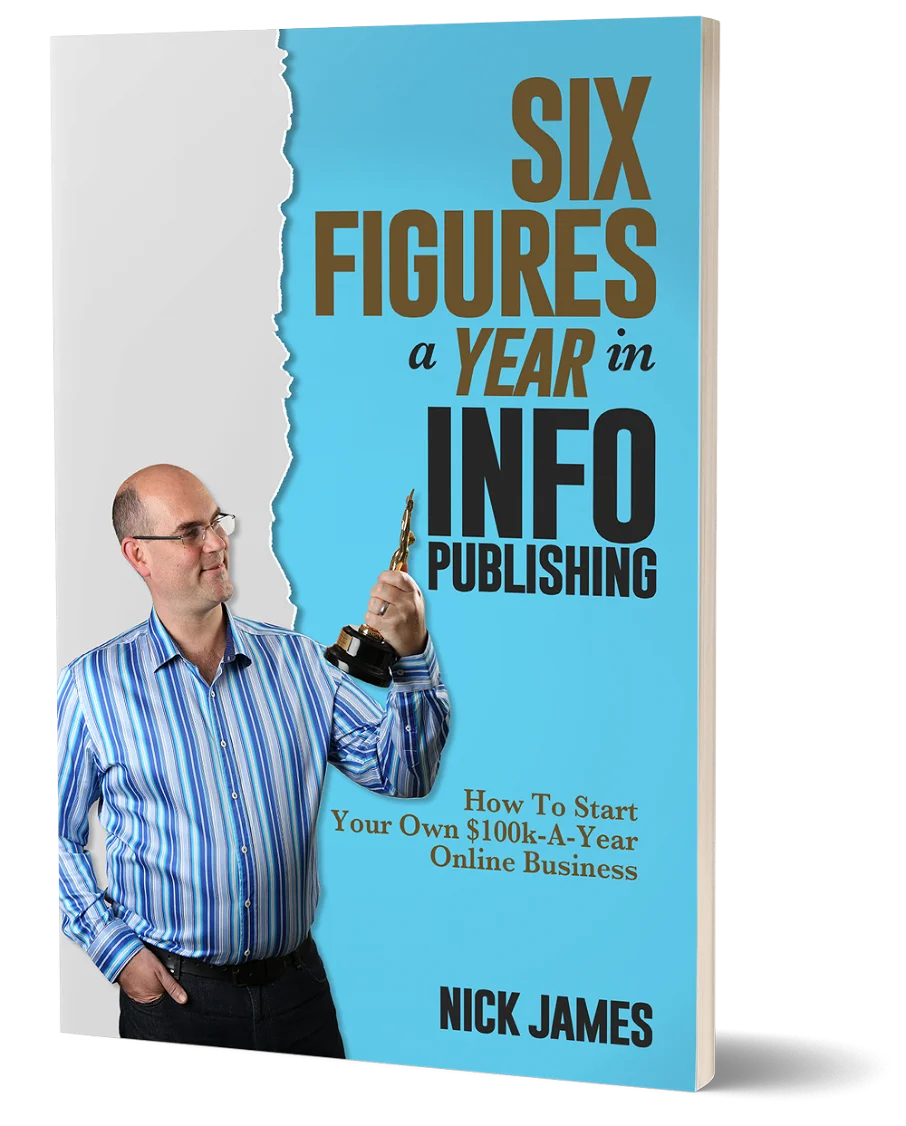
Author offers a FREE copy of this book to his next door neighbor... to prove he's not a drug dealer!
Now claim your FREE COPY.
and follow the step-by-step instructions for making the kind of money (and living the kind of lifestyle) that'll get your neighbors curtains twitching with curiosity!
Enter your details below to discover how to claim your FREE COPY of 'Six Figures A Year In Info Publishing' ...
Privacy Policy : We value your privacy. You can unsubscribe from receiving future emails with 1 click at any time.