Smart Beginners Skip The Big Idea And Win Their First Paying Customer
Picture this: ten browser tabs open, a notebook full of half-finished ideas, and a cursor blinking on a blank document called ‘business plan’. The kettle has gone cold twice. Nothing has happened yet.
If that sounds familiar, you are not short of ideas. You are short of proof. And the quickest way to get proof has nothing to do with building a website, picking a logo, or finding the perfect first-paying-customer idea before you dare to start.
It starts with one small, slightly uncomfortable question: would anyone pay for this, today, as it is?
Why Waiting For The Perfect Idea Holds You Back
Most beginners treat the idea stage as the whole job. Research it. Refine it. Research it again. By the time it feels ready, months have gone and nothing has been tested on a real person.
Picture two people starting the same week. One spends a month comparing business models, reading comparison posts, and redesigning a logo three times before writing a word of copy. The other spends an afternoon asking ten people in a Facebook group what’s frustrating them right now, then messages three of them directly. By the time the first person has picked a font, the second already knows whether anyone will pay. Speed to proof beats speed to perfection.
I came into this business later than most, after years running my own sash window restoration business. If I’m honest, the trades taught me something useful here: you don’t spend six weeks perfecting a quote before you know the customer has the job to give you. You find out fast, then build the right thing.
An online business works the same way. The idea does not need to be big. It needs to be small enough to test this week.
That is the order that gets missed most often: problem, then offer, then payment, then build. Reverse the order and you end up refining a solution nobody asked for, dressed up as research so it feels like progress.
Find The Problem Before You Find The Product
Start with people, not products. Pick a group whose problems you understand, even slightly: new Etsy sellers, local tradespeople, first-time coaches, anyone running a small service business.
Then go looking for what they are already complaining about. Reddit threads, Facebook groups, reviews, forum comments. What keeps coming up? What are they already paying someone else to sort out, badly?
Say you land on new Etsy sellers. Scroll through a few forum threads and you’ll likely see the same complaints again and again. Listings that don’t convert, photos that look amateur, descriptions that ramble without saying what the item solves. That repetition is the signal. One complaint might be a one-off. Ten people saying the same thing in different words is a problem worth building something around.
You are not inventing a need here. You are finding one that already exists and is currently being solved poorly or not at all.
I’ve written about this kind of groundwork before, in some of the other articles I’ve shared recently. It keeps coming back to the same point: the research matters more than the idea does.
Make One Small Offer
Once you can see a specific, recurring problem, build the smallest possible offer around it. Not a course. Not a membership. One deliverable, one price, one way to pay.
If a group of small business owners keep saying their listings look tired, offer to rewrite ten of them for a set fee. If they keep saying they don’t know what competitors are doing, offer a short report comparing five of them.
Keep the scope tight enough that you could deliver it inside a week. Kept going is easier when the thing you promised is small enough to finish.
Keep it painfully specific. ‘I’ll rewrite your Etsy listings’ is vague. ‘I’ll rewrite ten of your Etsy listings this week for $75, focused on the first line buyers see’ is something a person can say yes or no to today. The narrower the offer, the easier it is to judge whether it worked.
Write the offer in one sentence: who it is for, what they get, what it costs. That sentence is your whole pitch for now.
Ask For Money, Not Approval
Here is the part most people skip. They show their idea to friends, get encouraging nods, and mistake that for validation long before they’ve found a first paying customer.
A payment tells you something a compliment never will.
Think of it the way a tradesman prices a job. You don’t spend a fortnight perfecting a quote on your own. You take it to the customer and find out quickly whether the price and the job match what they’re willing to spend.
Friendly feedback costs the other person nothing. A payment means someone looked at what you’re offering and decided it was worth more than the money in their account.
It does not need to be a large amount. A small fee is still proof. If nobody pays, that’s useful too. It tells you the problem wasn’t painful enough, or the offer wasn’t clear, long before you’ve sunk months into building something bigger.
A no is information, not failure. It means something about the problem or the offer needs adjusting, not that the whole idea is wrong. Change one variable, the price, the wording, the person you’re asking, and offer it to the next person.
What Happens After Someone Pays
Once you have a first customer, the business starts teaching you things no amount of research could. What was most useful to them? What did they expect that you hadn’t thought of? That conversation shapes what you build next far better than guessing ever could.
Say your first customer pays for ten rewritten listings. Halfway through, they mention they also don’t know which of their five competitors ship faster or cheaper. That offhand comment is worth more than a month of market research, because it came from someone who had already paid you once.
From there, the pattern repeats. Find the second customer. Then the third. Tighten the offer each time based on what you’re hearing, rather than what you assumed going in.
This is also where it helps to have a proper, structured path to follow rather than figuring out every step alone. Nick James put together a programme called Serious About Six Figures, which walks through exactly this kind of groundwork. It takes a small validated idea and turns it into something closer to a proper, durable business. If you’ve just proved someone will pay you for something small, that’s the natural next step worth a look.
Start Smaller Than Feels Comfortable
None of this requires confidence you don’t have yet. My own belief that this business would work grew slowly, stage by stage, as I worked through the training. It wasn’t one dramatic moment, and the same will likely be true for you.
This is also why it helps to treat each small offer as a test rather than a verdict on your abilities. A quiet launch with no takers tells you something useful about the offer, not about whether you’re cut out for this. Adjust one thing and put it in front of someone new.
Find one problem, make one small offer, and ask one person to become your first paying customer. That’s a far better use of this week than another afternoon of research.
Best wishes, Dean
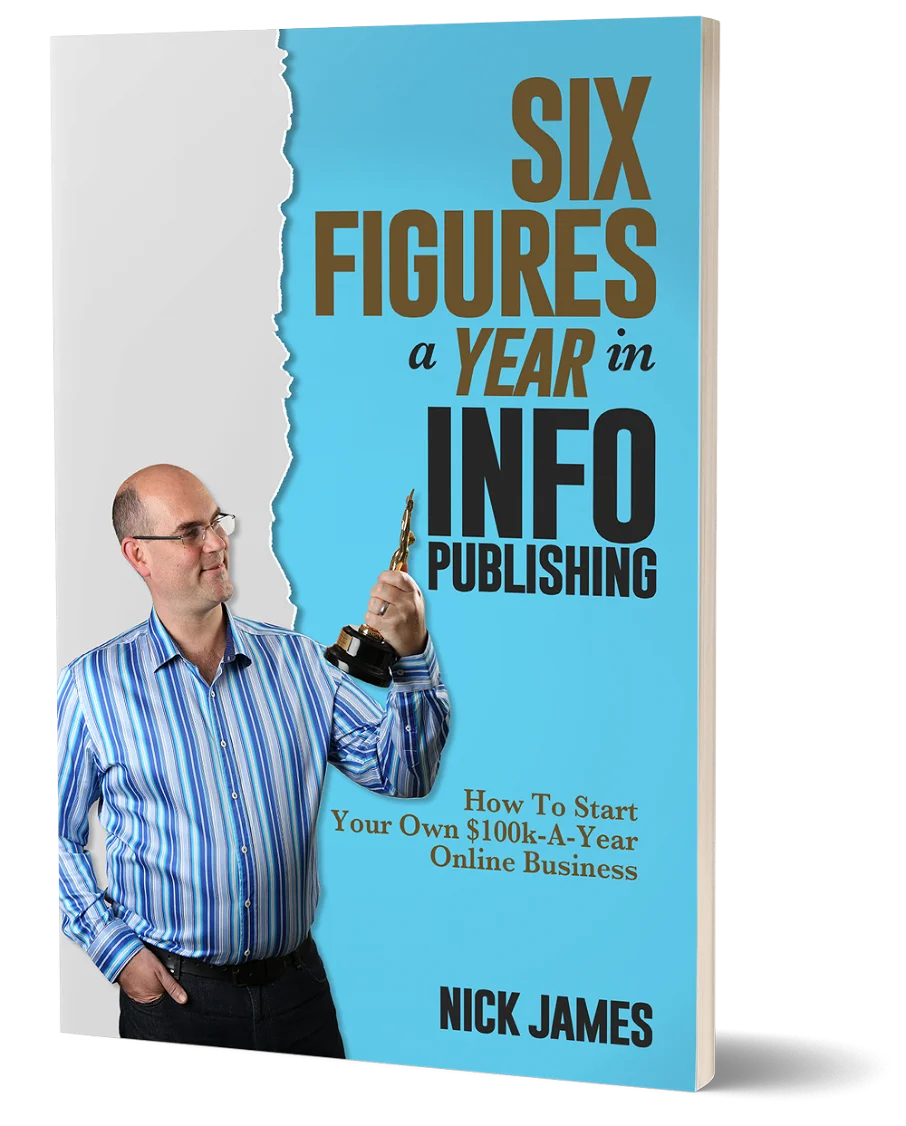
Author offers a FREE copy of this book to his next door neighbor... to prove he's not a drug dealer!
Now claim your FREE COPY.
and follow the step-by-step instructions for making the kind of money (and living the kind of lifestyle) that'll get your neighbors curtains twitching with curiosity!
Enter your details below to discover how to claim your FREE COPY of 'Six Figures A Year In Info Publishing' ...
Privacy Policy : We value your privacy. You can unsubscribe from receiving future emails with 1 click at any time.