Stop Guessing And Discover A Confident Way To Price Your Product
Picture the exact moment. You have built something you are proud of, an information publishing course, a guide, a template pack, and now there is a blank box on the screen waiting for a number. Your cursor just blinks at you.
You glance at what someone else charges for something similar. You pick a figure that feels about right, hit publish, and hope nobody asks you why. That is not a plan to price your product. That is a guess with a currency symbol in front of it.
If you are a complete beginner working out how to charge for the thing you have made, you are not the only one staring at that same blank box tonight.
Nick James once stood in a room and watched an organiser take close to $100,000 from fifty people before he had said a word. That moment changed how he thought about pricing for good, and there is a simple way of thinking behind it that any beginner can use.
The Formula Nick James Works Through Before He Sets Any Price
Nick James calls it the P.R.I.C.E. formula. Five factors, one for each letter, and together they tell you where your product truly belongs on the price map.
Product. Results. Income. Competitors. Extras.
Work through all five properly and the guessing stops. You get a number you can defend, not one you are quietly hoping nobody questions.
Start With The Product Itself
The first factor is the product in front of you. What topic is it. What format does it come in. Where are you selling it.
Business and money topics tend to support a higher price than hobby topics, because the return feels more direct to the buyer. A course delivered on video or with live sessions sits higher than the same content dropped into a plain document.
Where you sell matters more than most beginners expect. Sell through somebody else’s big marketplace and that platform can discount your work without asking you first. Sell it from your own site and that decision stays yours.
It is a bit like the trade I came from. You would not quote a job without knowing the materials, the access, and who is actually paying for it.
What Result Are You Delivering
The second factor is the transformation your product creates. Picture your reader’s life before they buy, then picture it after they have used what you taught them.
The bigger that gap, and the faster you close it, the more your product is worth. A result someone reaches in a week outsells the same result stretched over six months.
This is where real evidence does more work than clever writing ever will. If people have used what you built and ended up somewhere better because of it, that is your price argument already made for you.
Work Backward From The Income You Want
This is the factor Nick James says most people skip completely, and it is the one I found most useful once I understood it.
Before you fix on a number, decide what you want this product to earn you over the year. Then work backward from there.
Say the goal is $100,000. At $17 a copy, that is close to 5,900 sales. At $197, it is about 500 sales. At $997, just over 100 sales gets you there.
Five hundred sales of a $197 product reaches the same destination as thousands of sales of a cheap one.
That comparison alone is often the moment a publisher stops undervaluing their own work. It does not mean you should always charge more. A lower priced product still has its place. It means you price your product on purpose, with your income goal already in view, rather than backing into a number by accident.
Check What Everyone Else Is Charging
The fourth factor is your market. Look at what similar products already sell for. That tells you what your buyer already expects before they even land on your page, something I have touched on in other articles I have shared recently, and it is worth checking properly rather than guessing.
Then look for the gap. A crowded, general topic forces you to compete on price. A narrow, specific solution nobody else quite offers lets you compete on value instead, which is a far more comfortable place to be selling from.
The Extras That Quietly Change The Number
The final factor covers everything that gives your product an edge over something similar sitting next to it. Technical or advanced material tends to command more than beginner content. Information your reader cannot easily find elsewhere supports a higher price too.
Your own track record plays a part as well. Every result you have helped someone reach, every kind word from a buyer, every product you have already shipped adds a bit of weight. It counts the next time you set a number.
Building It The Way You Would Build Anything Properly
I have spent a lot of years fixing things that were built badly the first time round, whether that was a rotten window frame or a business decision made in a rush. Pricing is no different.
You do not get the number right by covering the guesswork with confidence you do not really feel. You get it right by working through the five factors properly, one at a time, the same way you would get the foundations right before touching anything else on a job.
I suppose you could say it is the same principle whether you are restoring a window or setting a price. Use the right tool for the job, and fix the actual problem rather than papering over it.
If I am honest, when I first sat down to price something I had made, I did the same thing most beginners do. I looked at what somebody else was charging and landed somewhere close to it. It took working through a proper process, and kept going long enough to finish it, before the number in the box stopped feeling like a guess.
Where This Fits Into A Bigger Picture
Pricing one product properly is useful. Building an actual business around a steady flow of products is a bigger job, and it is not one you have to work out alone.
Nick James put together an ongoing training programme for publishers who already have something to sell, called Serious About Six Figures. It is built for people who want steady, growing income rather than chasing the next shiny idea, with new training added most months.
If working out how to price what you have built has left you wanting a proper system for the rest of the business around it. That is worth a look.
You do not need every factor of the P.R.I.C.E. formula worked out perfectly by this weekend. You need one honest pass through it, on whatever you are closest to finishing right now, so you can price your product with a proper reason behind the number instead of a guess.
Pick the product sitting nearest to done, and give the number in that empty box a proper reason to exist.
Best wishes, Dean
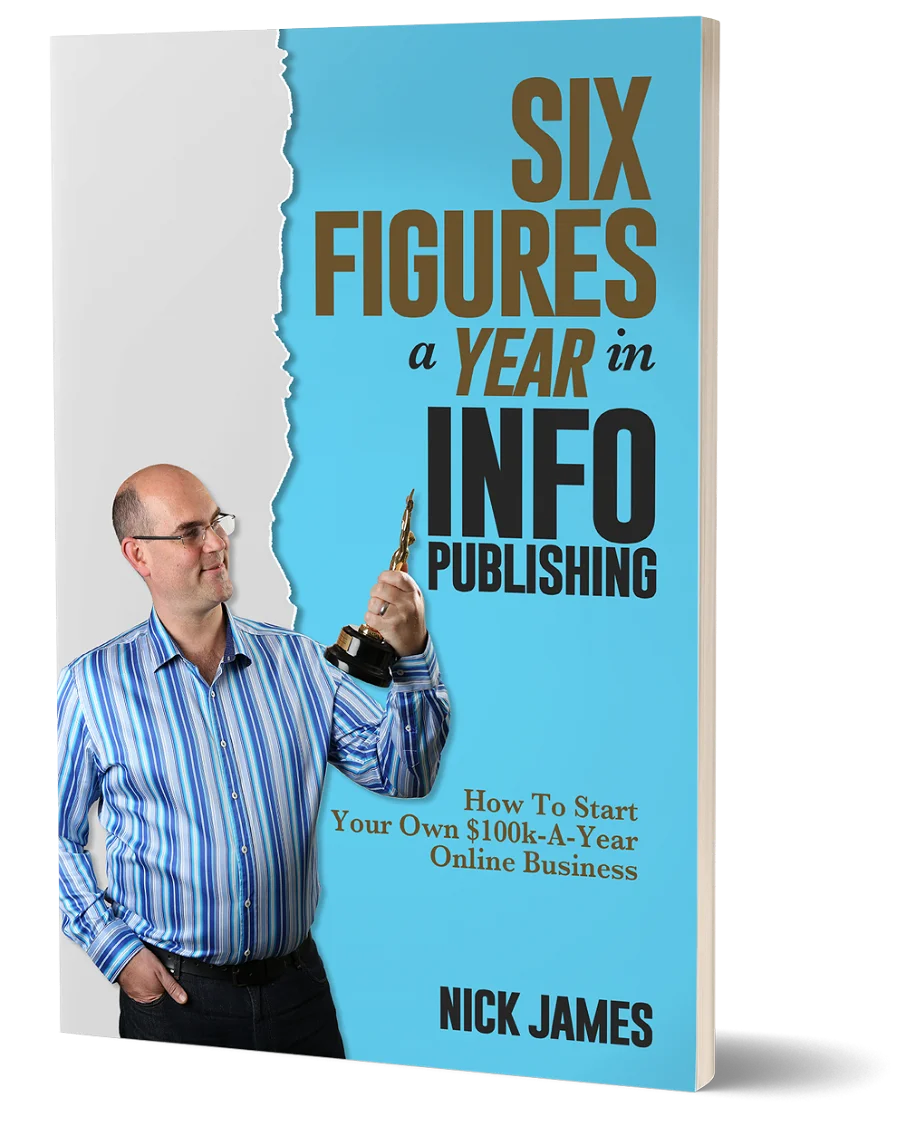
Author offers a FREE copy of this book to his next door neighbor... to prove he's not a drug dealer!
Now claim your FREE COPY.
and follow the step-by-step instructions for making the kind of money (and living the kind of lifestyle) that'll get your neighbors curtains twitching with curiosity!
Enter your details below to discover how to claim your FREE COPY of 'Six Figures A Year In Info Publishing' ...
Privacy Policy : We value your privacy. You can unsubscribe from receiving future emails with 1 click at any time.