The Overlooked Mistake Wasting Your Chance At Email List Growth
Most people trying to grow an email list believe the fix is more traffic. Post more often, get in front of more strangers, share the link one more time, and the subscribers will follow.
I don’t think that’s true. If I’m honest, I believed it myself for longer than I’d like to admit. When I started this business just over two years ago, I was chasing email list growth the same way most beginners do.
The real block to email list growth usually shows up earlier than traffic ever does. It’s the thing you’re offering in exchange for someone’s address. Get that wrong and no amount of traffic fixes it.
Fix the offer, not the traffic.
If you’re a beginner feeling overwhelmed by the sheer number of directions an online business could take, or you’ve jumped from one idea to the next without ever quite landing, this is worth reading properly rather than skimming.
Why More Traffic Rarely Fixes It
Traffic feels like progress. Numbers move, something is happening, and it’s easy to mistake activity for movement.
But a stranger who lands on your page doesn’t sign up because you reached them. They sign up because what you’re offering solves something they were already thinking about, in words close to their own.
Picture someone searching late at night for help with one nagging problem, phone in hand, half paying attention. They’re not looking for you specifically. They’re looking for the answer, and whoever hands it over in the clearest words gets the email address, whether that’s you or somebody else entirely.
Send fifty thousand of the wrong visitors to a page and you’ll get almost nothing back. Send two hundred of the right ones to a page built around one specific problem, and you’ll see a different result entirely.
If that’s you, the fix isn’t posting more often. It’s making sure the thing you’re offering matches what’s already on your mind before you ever click follow.
I’ve written more on this kind of practical thinking in other articles I’ve shared recently, and it keeps coming back to the same point: the traffic usually isn’t where the problem starts.
Specific Beats General, Every Time
A free report called something like Marketing Tips For Your Business tells a reader almost nothing. It doesn’t say what they’ll get, or why it matters to them today, so their eye slides straight past it.
Think of your own inbox for a second. How many free reports have you deleted without opening, because the title told you nothing about what was inside?
Compare that with something narrower: a short guide aimed at one exact problem, described in words that person already uses about themselves. That earns a second look before the reader has even finished the title.
A giveaway built for everyone ends up serving no one properly.
This isn’t really about writing cleverer titles. It’s about aiming your free giveaway at one person with one problem, rather than everyone with everything.
What My First Sale Taught Me
My own first sale in this world came long before I built this business. Back in 2007, maybe 2008, I sold a video set on email marketing by Cory Rudl, through a classified ad, for £49. I was in full-time employment at the time and not fully committed to it, so it went no further then.
What strikes me now is that the product itself was about building an email list, the same subject I’m writing about here. It wasn’t a general course on making money online. It was aimed at one specific skill, and that specificity is probably part of why it sold at all, even through something as basic as a classified ad.
The lesson carried forward when I started this business two years ago. A narrow, clearly aimed offer tends to outsell a vague one. That’s true whether you’re selling a £49 video set through a classified ad or a free report through a landing page today.
For you, the point is the same one that mattered to me back then: narrow beats broad, whatever you’re selling.
Borrow Proof Instead Of Guessing
You don’t need to invent a topic from nothing and hope your audience wants it. Look at what’s already selling on the platforms where your audience already buys: courses, guides, reports in your niche that keep appearing near the top.
Read the reviews too, especially the critical ones. People often spell out exactly what they wished a product had included, in their own words. That’s often the seed of a free giveaway worth building.
Say your niche is dog training. Look at the top-selling guides and courses on that topic, then open the negative reviews on each one. If several people say the same thing was missing, that’s your free giveaway sitting in plain sight. It’s already validated by other people’s money before you’ve spent a penny building it.
This works whether your audience is dog owners, guitar beginners, or people trying to fix their sleep. The specifics change; the method doesn’t. Find where they’re already spending money, then build the piece that closes the gap those buyers keep pointing at.
Validation beats invention every time.
A good giveaway does two things at once. It’s useful enough that someone gets a real result today, and incomplete enough that the obvious next question is one only you can answer.
Keep The Page Doing Less Work
Once the giveaway is specific, the page asking for an email address doesn’t need to be clever. It needs to know one reader, in one situation, with one frustration described back to them plainly.
State the benefit before the giveaway itself. Nobody wants a document. They want the outcome that document produces, spelled out in the first line they read.
Think about the last time you handed over your own email address for something. It probably wasn’t the design that convinced you, or the colours on the button. It was one line near the top that told you exactly what you’d get and why it mattered to you right then.
Keep the whole page short enough to read on a phone without endless scrolling. Put the sign-up box in only once everything above it has made that box feel like the obvious next step.
Where This Fits In My Own Business
I build my own sign-up pages through eShowcase, since that’s the tool I use for this side of the business. Keeping each page short has made more difference to how many people sign up than any design choice I’ve made inside it.
You don’t need the same tool to get the same benefit. Just keep your own page as short as you can make it.
None of this needs to be complicated. A specific topic, matched to a specific reader, delivered on an honest page, does most of the work before you’ve written a single clever line.
If the mismatch between your giveaway and your reader is the piece that’s been holding your email list growth back, there’s a complete system built around fixing exactly that. It’s called Lazy Way To Email Riches, put together by Nick James. It walks through matching a proven topic to a truly useful free giveaway, then building a simple landing page around it, one piece at a time. If you want to go further than one article can take you, it’s worth a look.
Building an email list well, once, properly, is worth more than chasing a dozen shortcuts later. Get the giveaway specific, keep the page honest, and the rest tends to take care of itself for you too.
Best wishes, Dean
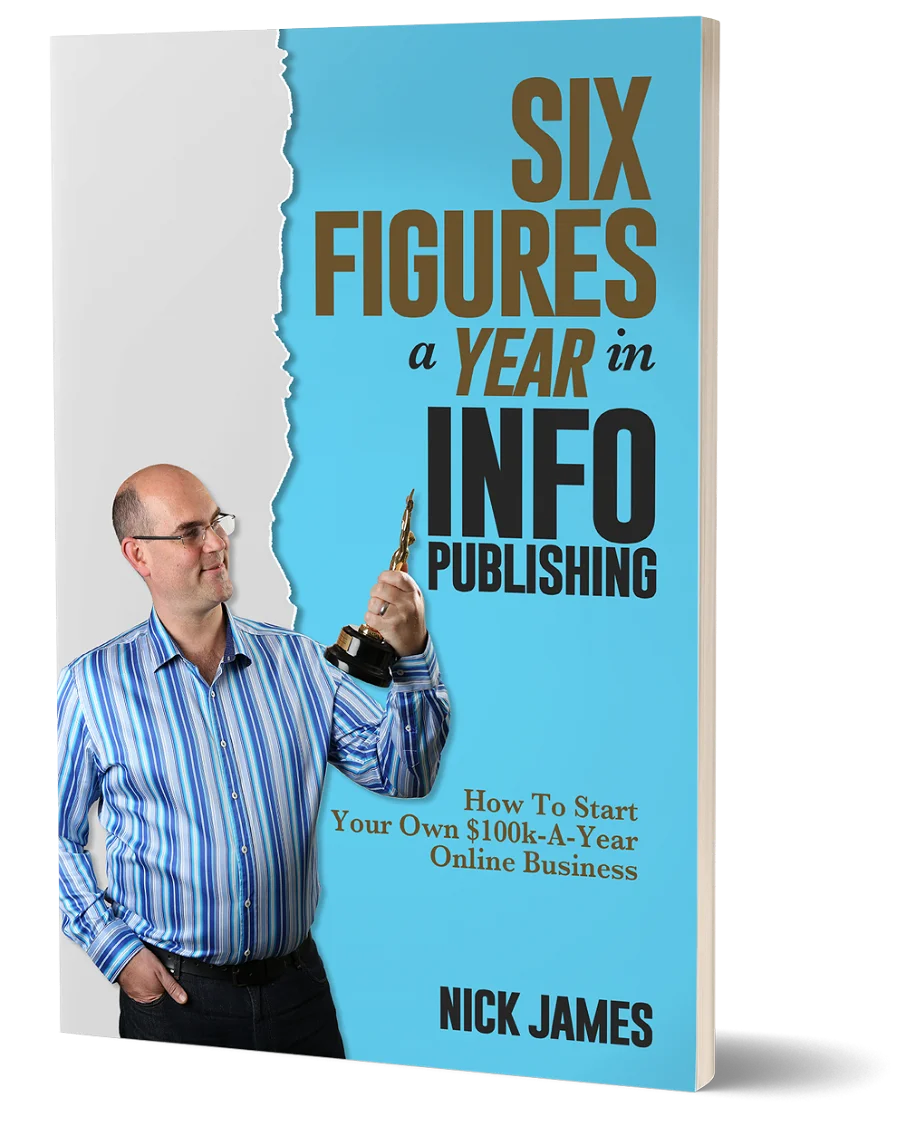
Author offers a FREE copy of this book to his next door neighbor... to prove he's not a drug dealer!
Now claim your FREE COPY.
and follow the step-by-step instructions for making the kind of money (and living the kind of lifestyle) that'll get your neighbors curtains twitching with curiosity!
Enter your details below to discover how to claim your FREE COPY of 'Six Figures A Year In Info Publishing' ...
Privacy Policy : We value your privacy. You can unsubscribe from receiving future emails with 1 click at any time.